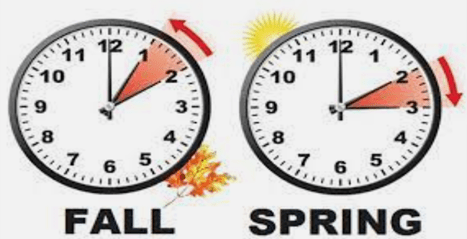
Daylight Saving Time (DST) undergoes a “Fall Back” by one hour on November 6, 2022, at 2 a. m. , in 13 provinces in Canada. This is when DST (or Summer Time) ends.

By Ransher Raj Singh Bhatti,
Student, Sir Winston Churchill High School, Calgary (Canada)
The idea of Daylight-Saving Time (DST) or Summer-Time was first given in 1895 by New Zealand-based entomologist George Hudson, who wanted to increase the amount of daylight available during working hours so that he had more time with better lighting for his studies. It is the practice of advancing clocks during warmer months so that darkness falls at a later clock time. We change our clocks during the summer months to move an hour of daylight from the morning to the evening. In winter, we do just the opposite, when there will be more light in the morning when we get up (one hour late) from bed.
In Spring, DST starts at 2 a.m. local time on the second Sunday in March. This is when we experience a “Leap forward”. It was a method used first in Germany and Britain in World War-I (1914 – 1918) to save fuel. During the War, 2 a. m. was the time when there were no trains traveling on the tracks. In Autumn, the reverse, “Fall back”, is done by moving the clocks back by one hour at 2 a.m., on the first Sunday of November. It minimizes energy consumption and lowers the incidence of traffic accidents. However, all countries that implement this exercise have different change dates.
In practice, only less than 40 % of the countries in the world accept this idea. Among others, China, Russia, and India do not follow it. In Canada, The DST was first observed in 1908. The Canadian provinces can independently decide about observing it or not. This year, the change (Fall back) is on November 6, in 13 provinces of Canada. Some parts of British Columbia (East, NE, SE), Nunavut, Ontario (NW), Yukon, Saskatchewan, and Quebec (East) do not change their clocks throughout the year. In the US, there are two states, Arizona, and Hawaii, that do not agree with this concept. The local time of a country or region which does not observe the DST is called Standard Time, Winter Time, or Normal Time. Its duration is shorter (being about 4.5 to 5 months in a year) compared to the DST or Summer Time, which is longer.
Spring (or Leap) Forward, Autumn (or Fall) Back
It is observed that ‘sleep cycles’, also called Circadian Rhythms, get disturbed by these changes. The reduction of one hour of sleep in the Spring season is more difficult to adjust than the addition of one hour of sleep in Autumn. Our body finds it easier to adjust to sleeping later (welcome) in the winter mornings than falling asleep earlier at night in the summer. The human body takes about a week to get used to these changes. Some people say we spend more money because we do more shopping after work if it is still light outside!
 ਸਾਂਝੀ ਵਿਰਾਸਤ