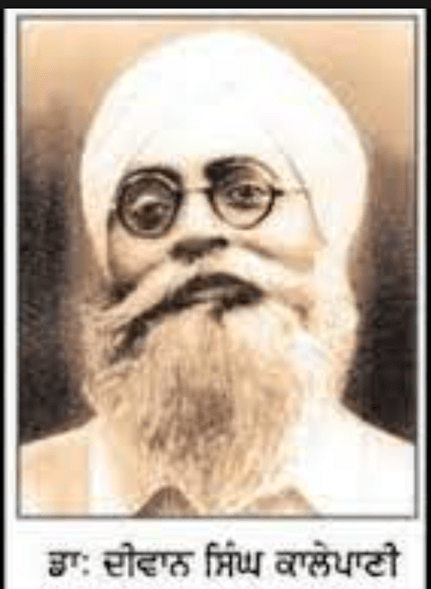
Shaheed Dr. Diwan Singh Ji ‘of Kalepani’
Dr. Diwan Singh was born on 12 May 1897 in Sialkot (in West Punjab). He went to study at Medical College, Agra, and then started his job in the Army Medical Services in 1919, at Lahore. He started interacting with great poets, writers, and thinkers of the idea of complete Swaraj, the Self-Rule of Indians, and Freedom from British Rule. A protest was planned by the people over the visit of the Prince of England to India. Dr. Diwan Singh participated in this protest and gave a speech in support of the complete Swaraj, or full Independence of India. He was arrested and prosecuted. As no one testified against him, he was acquitted and transferred to Rangoon (Burma).
Dr. Diwan Singh was then transferred to the remote island of Andaman, also called Kalapani. The common people there were mostly former prisoners who had served their sentences. Only police and government officers were allowed to enter the only Gurdwara there. He built a new ‘Gurdwara for all‘ in which many prisoners also participated voluntarily in the construction work. Sikhs, Hindus, Muslims, and Christians jointly constituted the Managing Committee.
This Gurdwara in Port Blair became a place for celebrating joint festivals and meetings for freedom struggle, along with Gurbani readings, Katha, and Kirtan. He next set up a school where education in Hindi, Punjabi, Tamil, Bengali, and Urdu was given to the children. An evening school was also established by him for working adults to impart professional skills to them, in the premises of the Gurdwara itself in Port Blair. Meanwhile, he published his poetry book ‘Flowing Water’ and worked for the freedom of India. During World War II, when British rulers in India realized they could not protect this island from the Japanese, they ordered all troops and others there to leave. But Dr. Diwan Singh decided to stay there and serve the local people.
In March 1942, the Japanese army took possession and made him the Chief Medical Officer (CMO) as well as Head of the Red Cross, the Peace Committee, and the Public Welfare Department. Dr. Diwan Singh formed a local branch of the Indian Independence League, the Azad Hind Army. The Japanese never liked these actions and ordered the evacuation of the Gurdwara and the use of all the medicines in his stock for the treatment of the Japanese only. Finally, Dr. Diwan Singh was arrested on 23 October 1943 and falsely accused of espionage. He was locked in a chamber of the cellular jail. After enduring extreme torture for about 80 days, on 14 January 1944, he died for the ideals of the welfare of the poor and the Freedom of India.
The Gurdwara he built there is now named after Dr. Diwan Singh. There is a Khalsa School where children of Bengali, Tamil, and other parents read Punjabi as a third language. In his memory, a Museum depicting his life story has been set up by his family at Chandigarh, with a statue of this great Freedom Fighter who was martyred for the Independence of India.
 ਸਾਂਝੀ ਵਿਰਾਸਤ