The Spectacular Total Solar Eclipse on April 8, 2024
Dr Surjit Singh Bhatti, Calgary (Canada)
Total Solar eclipses occur when the Moon entirely covers the Sun. The Moon passes between Earth and the Sun every month, but the plane of its rotation around the Earth is inclined at an angle of about 50 with respect to the plane of Earth’s rotation around the Sun. Hence, we do not have a Solar eclipse every month. Solar eclipses occur when the orbital planes of the Earth and the Moon, which keep changing, are in line with the Sun.
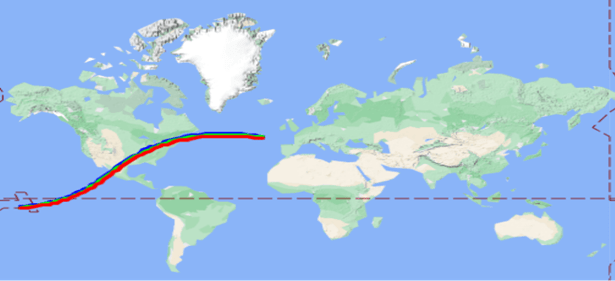
Path of the April 8 Solar Eclipse
The Moon’s shadow (umbra) will move at supersonic speed from Mexico to United States and finally into Eastern Canada. In Canada, it traces a narrow path (of about 115 miles wide) from Ontario to Quebec into New Brunswick, Prince Edward Island and Newfoundland. The temperature would drop, and Solar corona (outer bright rim of the Sun) shall appear, before the Sun is fully covered by the Moon.
A Total solar eclipse is a unique event where the Moon completely covers the Sun, but it is much different from a ‘Partial’ eclipse. In Canada, the ‘partial’part of the eclipse of April 8 will be seen on the western trail, at Vancouver from about 8-30 am, at Calgary from about 10-43 am and at Winnipeg from about 1.01 pm for short periods. ‘Total Solar eclipse on the eastern trail shall be seen at Toronto from about 2-04 pm, at Montreal from about 3-26 pm and at Halifax from about 4-27 pm onwards, leaving Canada at 5.16 pm NDT. Its path is shown by National Solar Observatory (NSO) and National Science Foundation (NSF).
The Mysterious Sun
Scientists use Solar eclipses to investigate some unsolved mysteries about the Sun. These include, among others, how the Sun’s core temperature is maintained around 15 million degrees Celsius, without cooling down, and why its outermost atmosphere is much hotter than its surface. It is observed that a stream of charged particles (Solar wind) released from the Sun, accelerates as it moves away from it. Sunspots are the temporary darker regions of reduced surface temperature caused by concentrations of magnetic fields. Their exact processes are still a mystery.
Some information about these mysteries is also provided by the Parker Solar Probe launched by the US-National Aeronautics and Space Agency (NASA) in 2018 and the Solar Orbiter launched jointly by European Space Agency (ESA) and NASA in 2020. Parker’s mission is to observe the outer corona of the Sun from a distance of about 4 million miles. Solar Orbiter is designed to obtain details of the Sun’s inner region and the origin of the Solar wind. It will also observe Sun’s polar regions from about 4.3 million miles from the center of the Sun. Both missions are expected to help us in forecasting major space-weather events that impact life on Earth
Getting the chance to see a Total Solar eclipse, if the weather permits, is an incredible educational opportunity. It has no effect on life on the Earth. However, eye safety is of the utmost importance, whether one is in the path of ‘totality’ or observes the ‘partial’ eclipse. One must protect the eyes using good ISO-compliant, ISO 12312-2 ‘Eclipse glasses’. Looking directly at the Sun without protection can permanently damage the eyes.
 ਸਾਂਝੀ ਵਿਰਾਸਤ