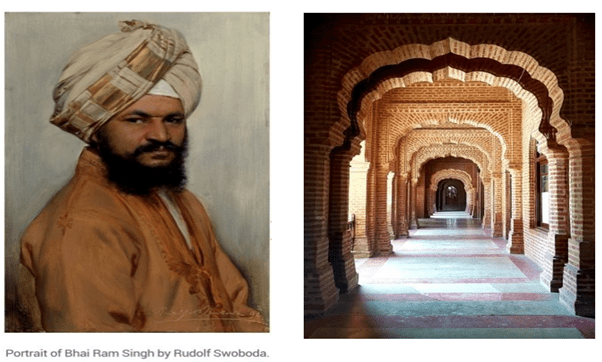
Punjab is proud of a brilliant Sikh, S. Ram Singh, who dominated the fields of Interior and Building Designs and amalgamated Oriental and European styles to produce a beautiful new Architectural Legacy for the Indian sub-continent. England invited him to produce new architectural designs of great historic value for their palaces. He created panels in Indian Motifs and shipped them to England to make the famous ‘Indian Billiard Room’ at Bagshot Park in Surrey, Southwest of London. The Queen was so impressed with the design of her Durbar Hall that she asked her court artist, Rudolph Swoboda, to paint S. Ram Singh’s portrait, which is now in the Osborne House, her summer home on the Isle of Wight. He was awarded the coveted titles of “Sardar Sahib”, “Sardar Bahadur”, Member of the Royal Victorian Order by King George V (MVO), and “Kaiser-e- Hind”.
Bhai Ram Singh was born in Rasulpur village near Batala (District Gurdaspur of Punjab) on 1 August 1858, graduated from the Mission School, Amritsar, and then went to Lahore in 1874 to join ‘The Mayo School of Industrial Art’, set up by sculptor John Lockwood Kipling (father of Nobel Laureate Rudyard Kipling). He also learned wood, ivory, marble carving, brass, bronze, and copper engraving. In 1883, he was appointed teacher at the Mayo School. He came into the limelight in 1889, as a co-winner (with famous architect Col. Swinton Jacob), in an All-India competition for the design of Aitchison College, Lahore. He designed the “Punjab Showcase” for Paris Universal Exhibition in 1900) and was appointed Principal of Mayo School (now National College of Art) in 1910. After retirement, he took over the family business in Mahan Singh Gate, Amritsar. He died on 23 December 1916.
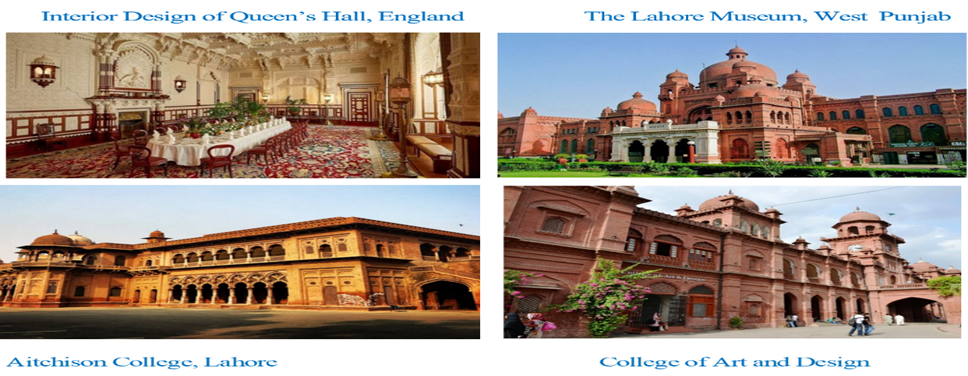
Indian and other Asian Architectural styles were associated only with places of worship. He prepared designs combining Indian schools with the Western approach, using local materials, in the revivalist style of Indo-Saracenic (or Indo-Gothic) architecture. He designed his alma mater, Punjab University, Lahore Museum, Chamba House in Lahore, Islamia College, Peshawar, palaces in princely states of Jind, Nabha, Patiala, Bahawalpur, Jammu & Kashmir, Mysore, and Governor’s House in Shimla. Khalsa College (conferred with Heritage Status) and the Saragarhi Memorials in Amritsar.
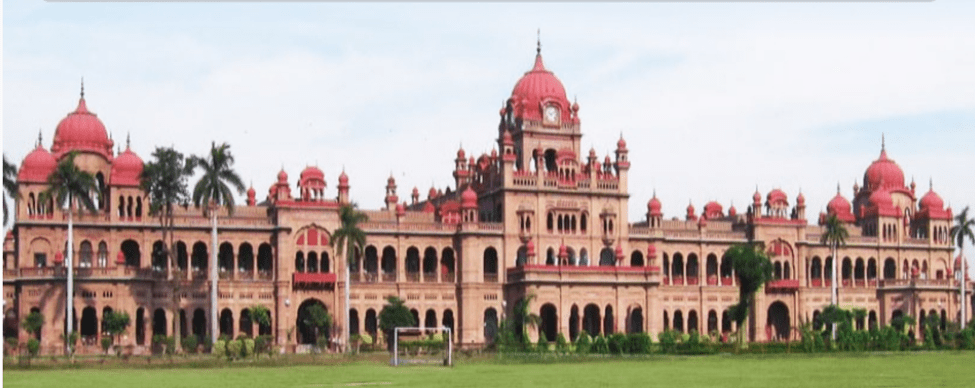
Bhai Ram Singh was a versatile designer of all types of buildings and furniture using indigenous motifs. He popularized the exquisite Pinjara Woodwork and carvings of Amritsar all over the world. He designed the interior and ambulatory in wood for New Mission Church, Peshawar, and the railing around the Sarovar of Darbar Sahib (Golden Temple), Amritsar. The Municipal Library-cum-Cultural Center of Amritsar is named in his memory. Bhai Ram Singh’s landmark creations are his lasting legacy to both East and the West.
Reference: 1.Vandal, Pervaiz, and Sajida. The Raj, Lahore, and Bhai Ram Singh – National College of Arts, Lahore (2006).
 ਸਾਂਝੀ ਵਿਰਾਸਤ
Very informative article which I have”nt ever learnt before. The only book about the Achievements of Sikhs in the worldly and secular fields I read is “The rise of Sikhs abroad” written by a journalist S, Gurmukh Singh. More efforts on this subject are required .
LikeLike